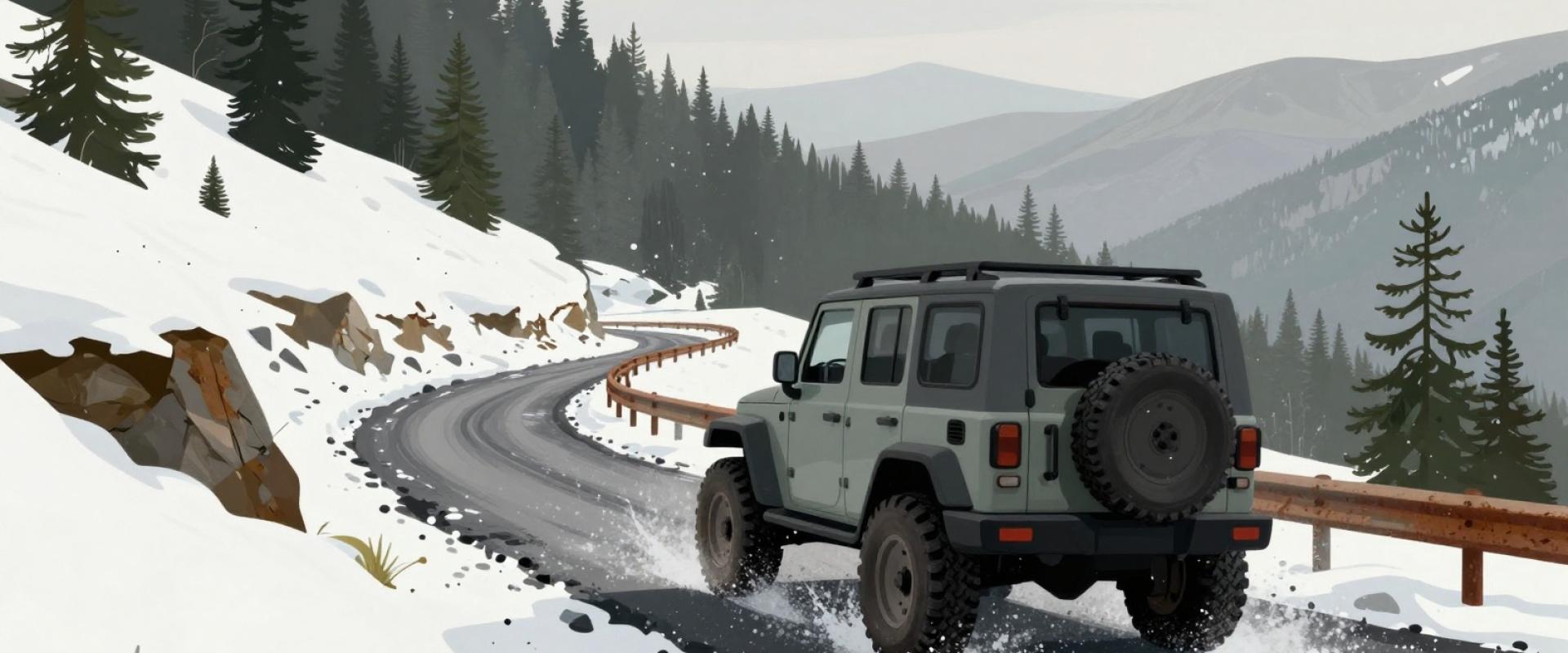
Where Winter Driving Gets Hard
Most of western Oregon gets rain, not snow, in winter. Portland, Salem and Eugene see snow only a few days a year in most winters, and the coast rarely holds it at all. The trouble starts when a road climbs. Every route that crosses the Cascades or the Siskiyous goes over a pass where snow, ice and chain requirements are routine from November into spring.
The crossings you are most likely to use:
- US 26 over Mount Hood, through Government Camp, the main road from Portland to Timberline and the Mount Hood ski areas.
- OR 35, the east side of the Mount Hood loop between Hood River and US 26.
- US 20 over Santiam Pass, between the Willamette Valley and Sisters and Bend.
- OR 58 over Willamette Pass, from Eugene toward Klamath Falls and the Willamette Pass ski area.
- I-5 over Siskiyou Summit, south of Ashland. This is the highest point on the whole of I-5, and storms can stop traffic here between Oregon and California.
- I-84 through the Blue Mountains, east of Pendleton, where the freeway climbs over Deadman Pass.
The Columbia River Gorge on I-84 has its own hazard: cold east winds can bring freezing rain and ice when the Willamette Valley is only wet. The Coast Range highways to the beaches are lower than the Cascade passes, but their summits can still ice over on cold mornings.
What the Chain Signs Mean
Oregon's chain law applies on every highway in the state, not only the mountain passes. ODOT posts the current requirement on fixed Snow Zone signs and lighted message boards, and the same requirements appear on TripCheck.com as blue circles on the map. There are four signs:
- Carry chains or traction tires. You must have chains or traction tires in or on the vehicle, the right size and enough of them. You do not have to put them on yet.
- Chains required on vehicles towing or with a single drive axle over 10,000 GVW. Ordinary cars that are not towing can carry on.
- Chains required on vehicles towing or weighing over 10,000 GVW. Trucks and anything towing must chain up.
- Chains required, traction tires allowed on vehicles under 10,000 GVW. A car or light truck that is not towing can use traction tires instead of chains.
Ignoring a chain sign is a class C traffic infraction, and ODOT warns that drivers who ignore a sign requiring chains or traction tires to be carried could face an $800 fine.
In the worst conditions ODOT can go further with a conditional road closure, which can require chains on all vehicles regardless of tires. A closure can read, for example, "chains required on all vehicles excluding four wheel drive vehicles unless towing", and traction tires do not count. ODOT or Oregon State Police staff are usually on site to explain it.
On the highest-risk routes, including Mount Hood, the Siskiyous and I-84 in eastern Oregon, there are chain checkpoints where drivers must stop so staff can check their equipment, and there are pull-outs to fit chains.
Traction Tires, Studs and the AWD Exemption
Traction tires are studded tires, retractable studded tires, or tires rated for severe snow, which carry the three-peak mountain and snowflake symbol on the sidewall. An ordinary all-season tire marked only M+S does not count as a traction tire.
Studded tires are legal only from November 1 through March 31. ODOT asks drivers to use them only when they really need them, because studs wear grooves into the pavement.
When chains are required on a car or light truck, they go on one tire on each side of the main drive axle.
All-wheel and four-wheel drive passenger vehicles are exempt from most chain requirements, but only if all of these are true: the vehicle weighs 6,500 pounds or less unloaded, it powers both front and rear wheels, it has mud and snow, all-weather radial or traction tires on all four wheels, it is not towing, it is driven so that it keeps traction, and it is carrying chains. That last condition catches many visitors: an AWD rental is not exempt if there are no chains in the trunk. The exemption also does not override a conditional closure.
Renting a Car for a Winter Trip
If you pick up a rental in Portland or Medford, ask before you leave the lot what tires it has and whether chains are provided or allowed. Some rental companies restrict fitting chains, so read the agreement. An AWD vehicle on snow-rated tires is the simplest way to meet most signs, provided you also carry chains. Our car rental and road trip tips cover the rest of the rental process.
Roads That Close for Winter
Some scenic roads do not stay open at all:
- McKenzie Pass (OR 242), the lava-field road over the Cascades west of Sisters, closes every November and usually does not reopen until June. Use Santiam Pass on US 20 instead.
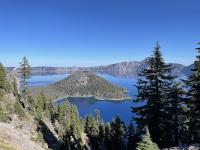
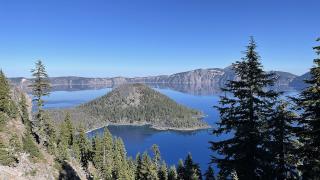
- Crater Lake National Park stays open all year, but the North Entrance Road and Rim Drive are not plowed and close for most of the year, roughly November to late spring or early summer. Highway 62 and Munson Valley Road to Rim Village are plowed through the winter, so the usual winter approach is from the south or west. In heavy storms the park can close the road up to Rim Village as well, and then there is no lake view by car. The winter entrance fee for a private vehicle is $20, valid for seven days.
Many Forest Service roads to trailheads are not plowed either, and a GPS route on a summer road can lead to a snowed-in dead end. Stay on highways that you know are maintained.
Sno-Park Permits
From November 1 to April 30, parking at a designated Sno-Park, the plowed lots used for sledding, snowshoeing and cross-country skiing, needs an Oregon Sno-Park permit. A one-day permit costs $4, a three-day permit $9 and an annual permit $25. They are not sold at the Sno-Parks themselves, so buy one beforehand from a DMV office, a permit agent such as a ski area or outdoor shop, or online through DMV.
Checking Conditions Before You Go
Check TripCheck.com before every mountain crossing. It shows chain requirements, road cameras, closures and crashes. You can also call 511 inside Oregon, or ODOT on 1-888-275-6368. Conditions can change within an hour on a pass, so check again if you stop along the way.
Pack for a long wait as well as a long drive: a full tank, warm clothes, water, food, a flashlight and a phone charger. Cell service is patchy on several passes and in eastern Oregon, so do not count on looking things up on the way. Our guide to Oregon cell coverage covers where signal drops out.
On the road itself, the usual rules apply: slow down, leave much more space than in the dry, brake and accelerate gently, and watch for black ice on bridges and in shaded curves. If a pass looks bad on TripCheck, waiting a few hours for plows is often quicker than a crossing in the middle of a storm.