Yaquina Head Lighthouse
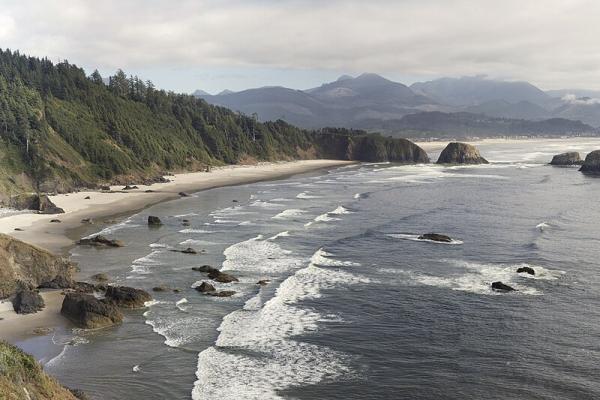
Yaquina Head Lighthouse stands on a narrow basalt headland that juts nearly a mile into the Pacific, about three miles north of Newport. At 93 feet, its white conical tower is the tallest lighthouse in Oregon. Work began in late 1871, and keeper Fayette Crosby first lit its lamp, fueled by lard oil, on August 20, 1873. The tower took more than 370,000 bricks, made in California and shipped up the coast, then hauled to the headland by wagon.
The original first-order Fresnel lens, made in Paris, is still in place, and the light is still an active aid to navigation. It was a steady, non-flashing light at first; since 1939 it has shown a distinctive pattern of two seconds on, two off, two on and fourteen off, repeating every 20 seconds. The light was automated in 1966.
The headland and lighthouse are protected as the Yaquina Head Outstanding Natural Area, managed by the Bureau of Land Management. There is an entrance fee per vehicle, and federal recreation passes are accepted.
Inside the Tower
The interpretive center near the entrance covers the lighthouse keepers' lives and the headland's marine life, and it is the place to ask about tower tours. Tours are led by rangers and limited to small groups. They run daily in the summer season, with passes handed out first come, first served at the interpretive center on the day, so arrive in the morning if a tour matters to you. Outside summer, tours depend on staffing and weather. At times, restoration work has limited tours to the ground floor; call ahead to check what is open.
Cobble Beach and Quarry Cove
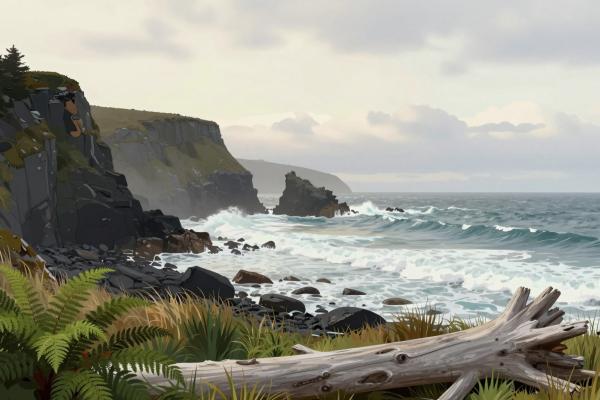
Below the lighthouse, a wooden staircase leads down to Cobble Beach, named for the smooth, fist-sized basalt stones that cover it. When waves pull back, the cobbles clatter against each other, a sound you will not forget. At low tide, the rocks at the edge of the beach reveal tide pools with ochre sea stars, green anemones, purple sea urchins, mussels and hermit crabs. The cobbles roll underfoot and the rocks are slippery with algae, so wear shoes with good grip and step on bare rock rather than living things.
If stairs are a problem, Quarry Cove, on the south side of the headland, was built from an old rock quarry and has paved paths that give easier access to tide pools. Time either visit for a low tide, ideally a minus tide, and check a tide table before you go.
Seals, Seabirds and Whales
Harbor seals haul out on the rocks just offshore, and you can often watch them from the stairs or the trail without disturbing them. Stay well back and keep your voice down; seals that flush into the water use energy they need. In spring and summer, the offshore rocks are crowded with nesting seabirds, including common murres, cormorants and gulls, and pigeon guillemots nest in the cliffs. Gray whales pass the headland on their migrations in winter and spring, and some stay near the coast through summer to feed.
Timing Your Visit
The natural area keeps daytime hours. Trails and beaches typically close in late afternoon, with longer hours in summer, so the headland itself is not usually a sunset spot. For sunset, walk the beach at Agate Beach just to the south, which has a view back to the lighthouse, or head to Nye Beach in Newport. Mornings are best at the lighthouse; summer afternoons can be windy and busy. Bring a warm layer at any time of year.
Newport's Other Lighthouse and More on the Coast
In Newport itself, Yaquina Bay Lighthouse sits on a bluff above the north end of the Yaquina Bay Bridge. It is a wooden house with the light on its roof, first lit in 1871 and taken out of service in 1874, after Yaquina Head's light took over. Believed to be the oldest building in Newport, it is open as a small museum in Yaquina Bay State Recreation Site and is furnished as a keeper's home.
If you are driving the coast, two other lighthouses make good companions. Heceta Head Lighthouse, first lit in 1894, stands on a headland about an hour south, north of Florence, and is reached by a short walk from the beach below. Cape Meares Lighthouse, on the Three Capes Scenic Route near Tillamook, is the shortest in Oregon, a stubby tower on a cliff that you look down on from the parking area.