

Sunsets on a West-Facing Coast
Oregon's entire coastline faces the Pacific, so in principle any beach is a sunset spot. In practice, a few places stand out because they add height, sea stacks or a river mouth to the view. The other variable is weather. From late spring through summer, marine fog often sits on the coast in the evenings, while early fall, roughly September and October, tends to bring the clearest sunsets. Winter storms can also produce dramatic skies between fronts.
Here are reliable spots from north to south, plus the safety basics.
Astoria: The Column and the Riverfront
At the mouth of the Columbia, Astoria offers sunsets over the river rather than the open ocean. The Astoria Column, on Coxcomb Hill above town, is the best viewpoint: a 125-foot tower with a spiral staircase of 164 steps to an observation deck overlooking the river, the hills and, to the west, the Pacific. The grounds close in the evening, so check hours if you want to stay until sunset; the park lawn itself gives a good view.
The Astoria-Megler Bridge crosses the Columbia to Washington, about four miles long. It is a striking backdrop, but do not stop on it: the bridge has no shoulders for parking. Watch from the Astoria Riverwalk instead, where the bridge and the sky line up to the west.
Cannon Beach and Ecola State Park
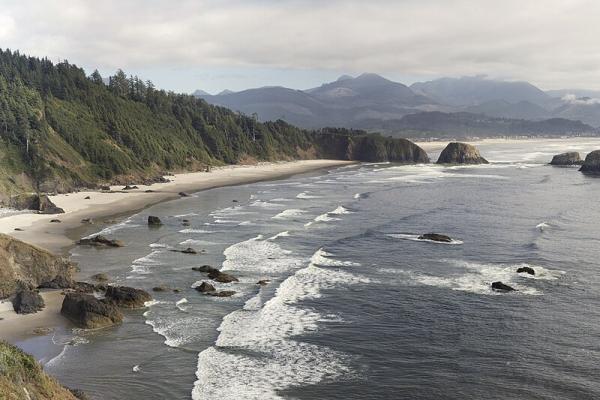
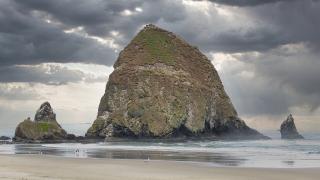
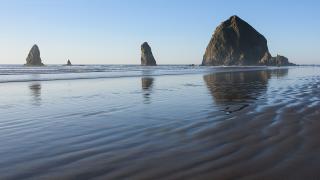
Haystack Rock at Cannon Beach is one of the most photographed sunset scenes in Oregon, and at low tide you can walk out near the tide pools at its base. For a higher view, Ecola State Park just north of town has viewpoints over Crescent Beach and the offshore rocks. The park charges a day-use fee and the road closes at dusk, so plan to watch from the viewpoints and leave promptly.
Central Coast: Cape Kiwanda to Cape Perpetua
- Cape Kiwanda, Pacific City: Climb the large sand dune above the beach for a view of Haystack Rock (a different one from Cannon Beach's) and the sandstone cliffs. Stay behind the fences on the headland; the cliff edges are unstable.
- Yaquina Head, Newport: The Yaquina Head Outstanding Natural Area, around the lighthouse, has a west-facing headland and seabird colonies on offshore rocks. Check closing times, as the gate is locked in the evening.
- Cape Perpetua, near Yachats: A road climbs to the Cape Perpetua overlook, about 800 feet above the ocean, one of the highest viewpoints on the coast that you can drive to. On a clear evening you can see a long stretch of coastline. Below, Thor's Well and Devil's Churn are best seen at high tide during daylight, not after dark.
Bandon and the South Coast
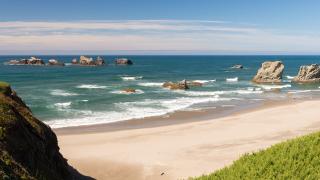
At Bandon, Face Rock State Scenic Viewpoint looks over a beach scattered with sea stacks, including Face Rock, which local legend describes as a young woman turned to stone. Stairs lead down to the sand. The sea stacks catch the low light well, and at low tide you can walk among them.
Farther south, Harris Beach State Park in Brookings and the viewpoints of the Samuel H. Boardman State Scenic Corridor offer more sea stacks with fewer people.
Staying Safe and Planning Your Evening
- Tides: Check the tide table before walking out to rocks or around headlands. A rising tide can cut off your route back, and that is easy to miss when you are watching the sky.
- Sneaker waves: Waves can surge much farther up the beach than the ones before. Never turn your back on the ocean, and keep children well back.
- Logs: Stay off large logs near the water; waves can lift and roll them.
- Cliff edges: Many headlands have crumbling edges. Stay behind fences and on marked paths.
- After dark: Bring a headlamp for the walk back, and note when park gates close.
- Timing: Arrive 30 to 45 minutes before sunset. The colors often peak 10 to 20 minutes after the sun goes down.
- Layers: Evenings on the coast are cool and windy, even in August.
- Photography: Wet sand at low tide reflects the sky, and sea stacks make strong silhouettes.
- Passes: Several state parks and federal sites charge day-use fees; carry a pass if you plan to visit a few.