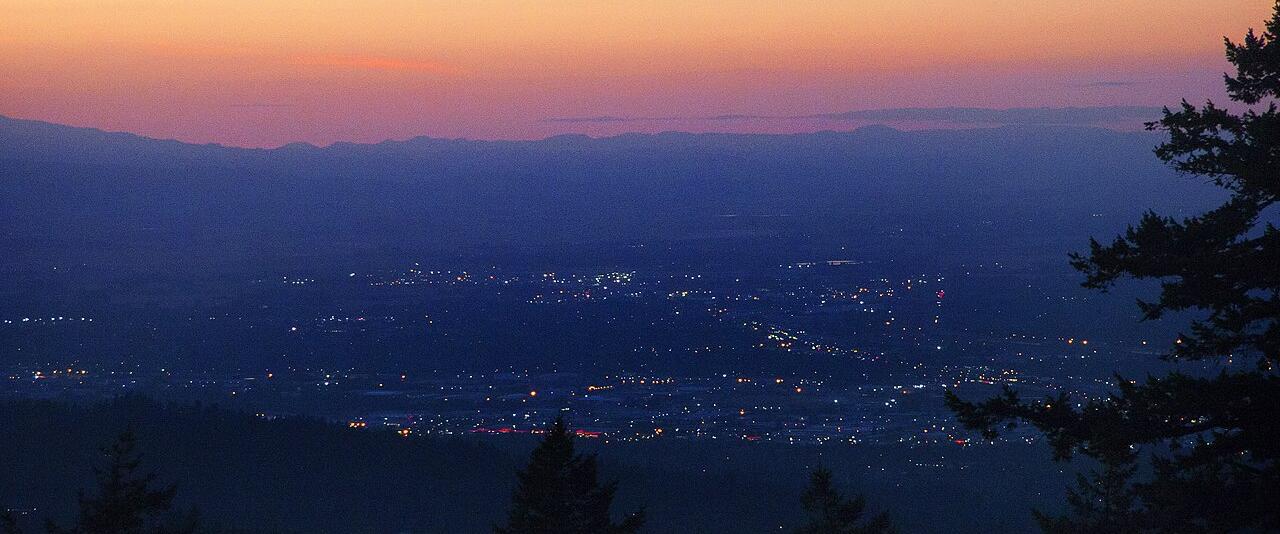
Eugene is a university town of about 175,000 people in the southern Willamette Valley, two hours south of Portland, and most visitors know it for Oregon Ducks game days. Yet this is where a track coach taught Americans to jog and ruined his wife's waffle iron making a better running shoe, where some of the oldest shoes ever found are on display, where a crafts market has run on the same corner since 1970, where a hippie fair became an institution, and where a team of medics and crisis workers showed the country a different way to answer a 911 call.
This is Eugene's bright side, in roughly the order it happened. Some of its claims are bigger than the evidence, and we say so where they are. Every chapter ends with something you can go and see.
Before 1846: The Kalapuya and the Whilamut
Long before the city, this stretch of the valley was home to the Kalapuya people, who managed the oak savannas with fire and gathered camas along the river. Their descendants are living communities today, among them the Confederated Tribes of Grand Ronde and of Siletz. The city now uses their language on the ground: the Whilamut Natural Area, 237 acres on the east side of Alton Baker Park, takes its name from a Kalapuya word for the rippling current of the river.
Where to see it today: walk the riverside paths through the Whilamut Natural Area toward Springfield and look for the Kalapuya Talking Stones, 15 basalt boulders, each carved with a Kalapuya word and its English meaning. Kalapuya elder Esther Stutzman chose the words and the places; the first stones were set around 2003.
 The Willamette River at Eugene, seen from the Frohnmayer footbridge. Image: Kingofthedead, CC BY-SA 4.0, via Wikimedia Commons.
1846: Skinner's Cabin
In 1846 Eugene Skinner filed a land claim at the foot of the butte that now carries his name and built a cabin on it. Emigrants who had come over the new Applegate Trail spent the winter in it before his family moved in the following spring. A post office called "Skinner's" opened in 1850, the town was laid out in 1852, and "Eugene City" was incorporated in 1862; the "City" was dropped in 1889.
 The replica of Skinner's cabin in Skinner Butte Park. Image: Visitor7, CC BY-SA 3.0, via Wikimedia Commons.
Where to see it today: a replica cabin stands in Skinner Butte Park, moved in 1996 closer to where the original is thought to have been (the exact spot is disputed). Climb or drive up Skinner Butte for the view over downtown and the river.
 Eugene from the top of Skinner Butte, with Spencer Butte on the horizon. Image: Laura Alier, CC BY-SA 3.0, via Wikimedia Commons.
1876: The University and Its Collections
The University of Oregon opened in 1876, and much of what makes the city distinctive grew out of it. Its art museum opened in 1933 in a building by the campus architect Ellis F. Lawrence, built around the Asian collection of more than 3,700 works given by Gertrude Bass Warner. It has been the Jordan Schnitzer Museum of Art since an expansion completed in 2005.
 The main entrance of the Jordan Schnitzer Museum of Art, opened in 1933. Image: Akendall, CC BY-SA 3.0, via Wikimedia Commons.
Where to see it today: the Jordan Schnitzer Museum of Art is at 1430 Johnson Lane on campus. The campus itself is open to walk, with its old brick halls and big trees.
1915 and 1970: Markets on 8th and Oak
Farmers have sold produce at the corner of 8th Avenue and Oak Street since 1915; the Lane County Farmers Market celebrated its centenary there in 2015 and now has a covered pavilion. On 9 May 1970 a second market opened alongside it: the Saturday Market, started by Lotte Streisinger with 29 vendors selling things they had made themselves. It is widely described as the oldest weekly open-air crafts market in the United States; the claim comes from the market and the local press, and there has been no independent check. It has been on the Park Blocks at 8th and Oak since 1983.
 The Saturday Market on the Park Blocks: only things the sellers made themselves. Image: Tamanoeconomico, CC BY-SA 4.0, via Wikimedia Commons.
Where to see it today: the Saturday Market runs every Saturday from 10 a.m. to 5 p.m., early April to mid-November, rain or shine, with more than 250 artisans; a Holiday Market moves indoors to the Lane County Fairgrounds from the weekend before Thanksgiving to Christmas Eve. The Farmers Market runs on Saturdays from spring to December and on Tuesdays in summer; check the dates each year.
1938: The Oldest Shoes
In 1938 the University of Oregon archaeologist Luther Cressman dug in Fort Rock Cave, in the high desert of central Oregon, and found dozens of sandals woven from sagebrush bark, lying under ash from the eruption of Mount Mazama, the volcano that formed Crater Lake. Radiocarbon dating in 1951 showed they were more than 9,000 years old. The university's museum dates the style to about 10,200 to 9,300 years ago and calls them the oldest directly dated shoes in the world; Guinness gives a similar range.
 Fort Rock sandals, woven from sagebrush bark about 10,000 years ago (this pair photographed at the Oregon Historical Society in Portland). Image: Ian Poellet, CC BY-SA 4.0, via Wikimedia Commons.
Where to see it today: the Museum of Natural and Cultural History, 1680 E 15th Avenue, shows Fort Rock sandals in its permanent exhibition "Oregon—Where Past is Present". It opens Wednesday to Sunday, 10 a.m. to 5 p.m., until 8 p.m. on Thursdays; adult admission is $7.
 The Museum of Natural and Cultural History on the university campus. Image: Visitor7, CC BY-SA 3.0, via Wikimedia Commons.
1950s: Gardens Given to the City
Two of Eugene's best-loved gardens were gifts. Hendricks Park grew from land given to the city in 1906 by T. G. and Martha Hendricks, and in 1951 a local camellia and rhododendron club began planting the rhododendron garden that fills it with colour every spring. On the riverbank, about 8.5 acres given by George E. Owen became the Owen Rose Garden, opened in the early 1950s.
 Rhododendrons in Hendricks Park, planted from 1951 onward. Image: Chris Phan, CC BY-SA 2.0, via Wikimedia Commons.
The rose garden has an older resident: a cherry tree planted in the 1860s and listed as an Oregon Heritage Tree, recorded as the largest of its kind in the state. A popular story says Eugene Skinner planted it in 1847; that part is folklore.
 The arbour walk through the Owen Rose Garden by the Willamette. Image: Rick Obst, CC BY 4.0, via Wikimedia Commons.
Where to see it today: Hendricks Park is on the hill east of the university, best from late April to May. The Owen Rose Garden is by the river at 300 North Jefferson Street; the roses peak in June.
1962 to 1974: Bowerman, Jogging and the Waffle Iron
In 1962 the University of Oregon track coach Bill Bowerman travelled to New Zealand, where the coach Arthur Lydiard showed him ordinary people running for their health. Back in Eugene he started fitness runs for the public, and in 1966 he published a short book with a cardiologist, W. E. Harris, called Jogging. It helped turn the idea into a national habit. In 1964 he and a former runner of his, Phil Knight, had started an importing business on a handshake: Blue Ribbon Sports, which became Nike.
Around 1971, looking for a lighter sole with grip, Bowerman poured rubber into his wife Barbara's waffle iron and ruined it. The pattern led to the Moon Shoe of 1972 and the Waffle Trainer of 1974. The iron itself was later buried at the family property and dug up in 2011; it went to Nike, near Portland, and is not on public view.
 Hayward Field, rebuilt and reopened in 2020, with its tower. Image: Rick Obst, CC BY 2.0, via Wikimedia Commons.
Where to see it today: Hayward Field, 1580 E 15th Avenue, has been the university's track since 1919. It was rebuilt with Phil Knight as the main donor and reopened in 2020, and in 2022 it hosted the World Athletics Championships, the first held in the United States. The city calls itself TrackTown USA. See the stadium from outside any day, or come for a meet; the Prefontaine Classic is held here every summer.
1969 and 1970: The Fair and the Clinic
Eugene became a centre of the West Coast counterculture, and two of its creations are still going. The Oregon Country Fair began on 1–2 November 1969 as a fundraiser for an alternative school and moved in 1970 to woods on the Long Tom River near Veneta, about 13 miles west of town. It now draws about 35,000 people over three days, with nearly a thousand booths, music and theatre in the trees.
The same year, people from the same world opened the White Bird Clinic to give free care to young people in trouble. In 1989 it started CAHOOTS with the city: a medic and a crisis worker sent through the police dispatch line to mental-health calls, welfare checks and people in distress, without police. At its height it took more than 65 calls a day. Denver, Oakland, Olympia and Portland later built programmes on its model. In April 2025 the service in Eugene ended after a funding dispute, while the Springfield service continued; in 2026 Eugene started a different peer-navigation programme. The idea outlived its home city, for now.
Where to see it today: the Oregon Country Fair is held on the Friday to Sunday of the second full weekend in July, and it is alcohol- and drug-free. There is nothing of CAHOOTS to visit; it lives on in other cities.
1970: Bach in the Valley and Bikes by the River
In 1970 the German conductor Helmuth Rilling and the university's Royce Saltzman founded the Oregon Bach Festival, which brought choirs and orchestras to Eugene every summer for more than half a century. In 1982 the city opened the Hult Center for the Performing Arts, paid for with money its voters approved in 1978.
 The Hult Center, opened in 1982 and paid for by a public vote. Image: Rick Obst, CC BY 2.0, via Wikimedia Commons.
The same year Eugene set up a bicycle committee, and in 1972 the city put money into paths along both banks of the Willamette. Ruth Bascom, a member of that committee who later became the city's first woman mayor, gave her name to the result: the Ruth Bascom Riverbank Path System, now about 19 miles of paved paths. In 2014 Eugene passed its Climate Recovery Ordinance, one of the first in the country to set climate targets in city law.
 The Peter DeFazio footbridge, one of the crossings on the riverbank paths. Image: Rick Obst, CC BY 2.0, via Wikimedia Commons.
Where to see it today: the Oregon Bach Festival is held from late June to early July. Rent a bike and ride the riverbank loop: cross on the Peter DeFazio Bridge to Alton Baker Park and back over the Frohnmayer footbridge.
1975: Pre's Trail
Steve Prefontaine, from Coos Bay, ran for Bowerman at Oregon and at his death held every American outdoor record from 2,000 to 10,000 metres. He admired the soft forest trails he had run in Europe and Scandinavia and pushed for something similar at home. He died on 30 May 1975, aged 24, when his car crashed on Skyline Boulevard. Within months, Lane County, the Oregon Track Club and Bowerman built the trail he had wanted, and about 500 people ran its opening.
 Runners on Pre's Trail, the bark-chip trails in Alton Baker Park. Image: ChunkySoup at en.wikipedia, Public domain, via Wikimedia Commons.
Where to see it today: Pre's Trail runs for about 4 miles of bark and woodchip loops through Alton Baker Park, reached from Martin Luther King Jr Boulevard near Autzen Stadium. Pre's Rock, the memorial on Skyline Boulevard near Hendricks Park where he died, is visited by runners from around the world, who leave tributes there.
1973 and 1987: Places for Nature
In 1973 volunteers founded the Mount Pisgah Arboretum on land leased from Lane County at the foot of Mount Pisgah, southeast of the city: 209 acres of oak savanna, meadows and river forest. In 1987 the Cascades Raptor Center opened to care for injured birds of prey, releasing those that recover and giving a home to those that cannot fly again.
 The Coast Fork of the Willamette at the Mount Pisgah Arboretum. Image: John M. DeMarco, CC BY-SA 4.0, via Wikimedia Commons.
Where to see it today: the arboretum's trails are open daily; its Wildflower Festival in May and Mushroom Festival in October have run since 1981. The Cascades Raptor Center, 32275 Fox Hollow Road, opens Tuesday to Sunday from 10 a.m. to 5 p.m., with about 30 resident owls, hawks, falcons and eagles.
 The Cascades Raptor Center, which cares for injured birds of prey. Image: Visitor7, CC BY-SA 3.0, via Wikimedia Commons.
2003 and 2006: Kesey Square and the Whiteaker
Ken Kesey, author of One Flew Over the Cuckoo's Nest, studied at the university and lived for most of his life on the family farm at Pleasant Hill, just outside town. In 2003 a bronze of him reading to his grandchildren, The Storyteller by Pete Helzer, was unveiled downtown; the square became officially Kesey Square in 2017, after a plan to sell it was dropped.
In 2006 two local brewers started Ninkasi, named after the Sumerian goddess of beer, and the next year moved into the Whiteaker neighbourhood, which has since filled with breweries, cideries and food carts.
 Ninkasi Brewing in the Whiteaker neighbourhood. Image: Visitor7, CC BY-SA 3.0, via Wikimedia Commons.
Where to see it today: Kesey Square is at Broadway and Willamette Street, in the middle of downtown. Ninkasi's tasting room is at 272 Van Buren Street.
How to See Bright Eugene
A self-guided walk and ride, about 6 km. Start at the Saturday Market on the Park Blocks, then walk two blocks to Kesey Square. Head north to Skinner Butte Park and the replica cabin, and climb the butte. Pick up the riverbank path east past the Owen Rose Garden, cross the DeFazio Bridge into Alton Baker Park and run or walk a loop of Pre's Trail. Cross back to campus for Hayward Field, the Museum of Natural and Cultural History and the Jordan Schnitzer Museum of Art.
 Downtown Eugene and Skinner Butte from Hendricks Park. Image: Rick Obst, CC BY 2.0, via Wikimedia Commons.
Further afield:
- Hendricks Park and Pre's Rock on Skyline Boulevard.
- The Mount Pisgah Arboretum and the Cascades Raptor Center.
- The Oregon Country Fair site near Veneta, in July.
Dates to know:
- Saturdays, April to mid-November: the Saturday Market.
- May: the Mount Pisgah Wildflower Festival; rhododendrons in Hendricks Park.
- June: roses in the Owen Rose Garden.
- Late June to early July: the Oregon Bach Festival.
- Summer: the Prefontaine Classic at Hayward Field.
- Second full weekend of July: the Oregon Country Fair.